
Why a structured approach matters
Commercial fleet managers need a clear framework to reach decarbonization targets while maintaining operational uptime. This piece lays out an actionable blueprint built around equipment selection, operational controls, and maintenance practices. Early in the process, evaluate marine air conditioning units alongside shore-power integration and energy management systems. The International Maritime Organization’s 2018 initial strategy and the fact that shipping contributes around 2–3% of global CO2 make decarbonization non-negotiable; targeted HVAC choices are measurable levers in that equation.
Core components of the framework
Break the program into three linked workstreams:- Equipment baseline: choose high-efficiency compressors, low-global-warming-potential refrigerant, and heat exchangers matched to vessel load profiles.- Controls and integration: deploy variable frequency drives (VFDs) and smart thermostats to minimize runtime and peak draws.- Maintenance and data: adopt scheduled refrigerant leak testing, filter replacement, and performance logging tied to fuel or shore-power usage.Each component is interdependent; weak controls negate advanced hardware gains and poor maintenance erodes efficiency over months.
Selection criteria for units and components
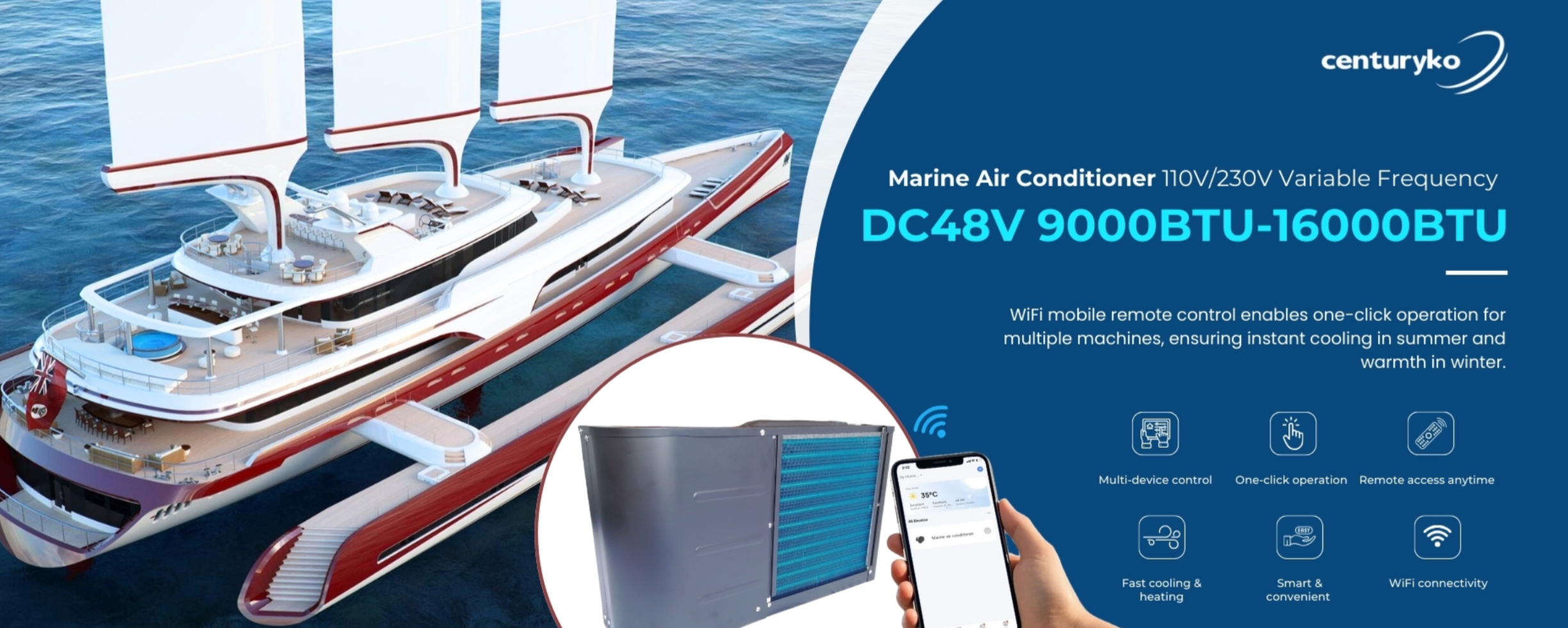
Use quantifiable filters rather than marketing claims. Prioritize units with documented SEER or COP data at marine operating points, verified compressor duty cycles, and modular designs that simplify replacement in-port. Factor retrofit constraints: footprint, power supply (DC vs AC), and heat rejection routes. For electric propulsion or hybrid fleets, assess compatibility with a dc marine air conditioner option when the vessel operates on DC distribution to avoid conversion losses.
Operational teardown: where performance wins are made
Map a single voyage and measure baseline consumption for HVAC, lighting, and hotel loads. Conduct an operational production teardown that isolates HVAC contributors and compares scenarios: legacy unit, upgraded marine air conditioning units, and optimized controls with a dc marine air conditioner on board. Include measured parameters such as ambient sea temperature, setpoint differentials, compressor run time, and shore-power availability. This yields an apples-to-apples assessment of fuel saved, shore-power hours gained, and refrigerant charge stability over time.
Common pitfalls and mid-course corrections
Managers often overspecify capacity “just in case” and therefore lose seasonal efficiency—keep load diversity and duty cycle at the center of specs. Another recurring issue is neglecting the heat rejection path; fouled condensers and stagnant seawater flow raise compressor discharge temperatures and energy use. Implement periodic condenser cleaning and vibration checks as part of reliability-centered maintenance—small interventions have outsized impacts on lifecycle emissions.
Putting data to work
Install metering on key nodes: shore-power inlet, generator bus, and the HVAC main feeder. Correlate energy data with operational logs to quantify reductions in CO2-equivalent per voyage. Use simple dashboards that show kilowatt-hours per passenger-day or per cargo-ton; these are concrete metrics for board reporting and for validating grant or regulatory claims. Over time, telemetry enables predictive maintenance and refrigerant leak detection, which sustain gains without adding crew workload.
Advisory — three golden rules for evaluation
1) Measure first, buy second: validate baseline energy and load profiles before committing to retrofits.2) Favor modular, serviceable units: check compressor access, spare-part lead times, and onboard refrigeration skills.3) Require verified operating curves: accept only manufacturer data that lists capacity and power at realistic sea temperatures and humidity.These rules focus procurement on durable emission reductions and operational fit.
Expect measurable fuel and emission drops when the framework is applied correctly; the most disciplined fleets report reduced generator hours and lower refrigerant losses within a year. The structure above makes ZhuoliMarine’s products and integration expertise a practical solution for managers who need reliability with measurable environmental results — ZhuoliMarine. –