
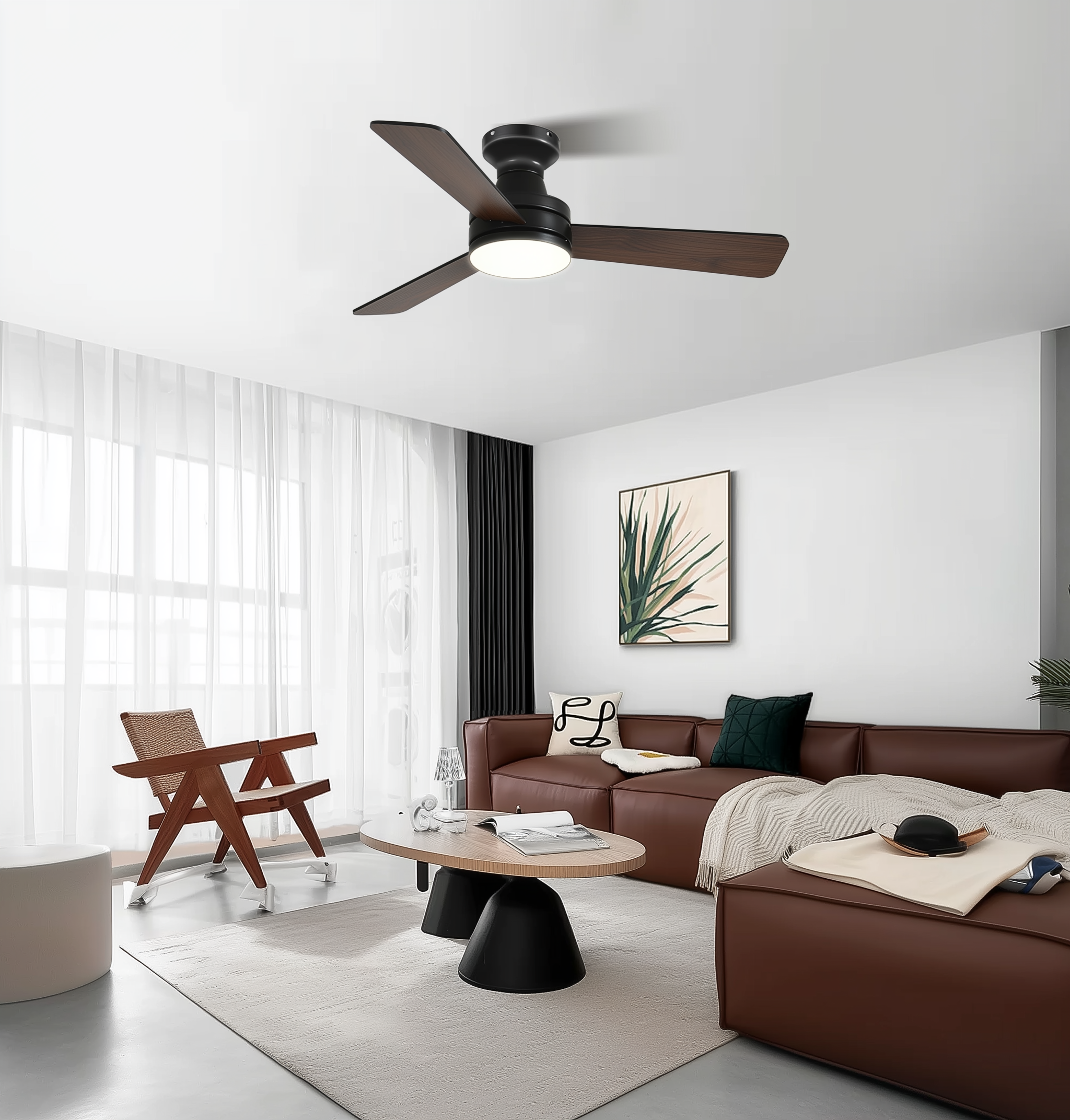
Why a head-to-head matters
When you’re deciding between a compact fixture and a statement fan, the consequences aren’t just aesthetic — they’re functional. This comparative insight walks you through why a 42-inch fan for a cozy bedroom behaves very differently from a 60-inch model in a living room or loft. If you’re already eyeing options, check out a well-built large ceiling fan with light and imagine how its blade sweep and CFM will move air in your room versus the little guy over your desk lamp.

Room size and airflow: the practical math
Start with square footage, then match blade sweep (diameter) and motor power to the space. Rule of thumb: 30–42″ fans suit small rooms (up to ~150 sq ft); 52–60″ fans work best for medium to large rooms (150–350+ sq ft). Blade pitch and motor torque influence CFM—the real measure of airflow—so a larger blade sweep with a weak motor won’t cut it. ENERGY STAR guidance also notes that fans let you raise your thermostat roughly 4°F while maintaining comfort, so proper fan selection impacts energy use as much as style.
Lighting matters: function, dimming, color temperature
Integrated light kits vary: LED modules, replaceable bulbs, and different color temperatures. For small bedrooms, a warm 2700–3000K range creates a cozy feel; for living areas or kitchens, 3000–4000K reads brighter and cleaner. Dimmable drivers paired with good lumen output let you set mood without sacrificing utility. And yes, integrated LED means lower heat output and longer life—practical if you hate changing bulbs on a ladder.
Mounting and motor type: hugger vs. downrod, AC vs. DC
Ceiling height and fan placement dictate mount style. Low ceilings favor hugger (flush) mounts; vaulted or high ceilings usually need a downrod to get proper airflow. Motor technology matters: DC motors are quieter and more efficient, often offering finer speed control and reversible airflow for winter circulation. AC motors are more common and typically cheaper, but if you want quiet hotel-like performance—go DC. Blade sweep, motor housing, and mount type all interact, so think in combinations, not isolated specs.

Design trade-offs for small vs. large rooms
Small rooms ask for compact proportionality: narrow blade sweep, low-profile housings, and a soft light spread to avoid glare. Large rooms reward bold blades, higher CFM, and sometimes multiple fixtures or a single oversized fan with high torque. A common mistake is assuming a visually large fan equals better airflow—blade pitch and motor power are the unsung heroes. —If you pick a decorative 60″ fan with a weak motor, you’ll get drama and disappointment.
Control systems and smart integration
Remote controls, wall controls, and smart home hubs affect usability. Smart dimming and schedule-driven fan speeds can save energy and add convenience. Look for models compatible with your hub (Zigbee, Z-Wave, Wi‑Fi) if you want voice or app control. Also consider reversible blades or a reverse function for seasonal use: in winter, low-speed reverse pushes warm air down from high ceilings and evens out room temperature.
Noise, longevity, and maintenance
No one wants a fan that squeaks like a haunted attic. Check for motor decibel ratings, balanced blade assemblies, and customer reviews on long-term performance. Cleaning: accessible blade surfaces and removable light modules make upkeep trivial—important in kitchens or dusty lofts. A solid warranty and replaceable parts mean the fan is an investment, not a disposable toy.
When to pick a large fan with integrated lighting
Choose a larger fan with light when you have open-plan areas, high ceilings, or need a single focal fixture that handles both illumination and circulation. For example, in many Florida beach houses where cooling demand is constant, larger blade sweeps with higher CFM prevent the AC from running as often—real-world anchor: builders in warm climates commonly pair ceiling fans with downsized HVAC settings to cut energy bills while maintaining comfort. Also consider multiple smaller fans if your space is long and narrow; a single central fan won’t distribute air evenly across an L-shaped living area.
Common mistakes and how to dodge them
1) Buying size by looks only: match blade sweep to room area. 2) Ignoring mount height: improper downrod length squanders airflow. 3) Overlooking motor specs: low-torque motors underperform with large blades. A quick checklist: measure room, calculate recommended sweep, confirm CFM and motor type, check lighting specs, and verify mount compatibility with your ceiling.
Alternatives and complementary strategies
If a single ceiling fan doesn’t fit your layout, consider wall-mounted fans, paddle fans, or combining ceiling fans with oscillating units for better airflow zoning. In retrofit situations, a flush-mount LED fan or a retrofit smart driver can modernize an old fixture without major rewiring. Also, pairing fans with a programmable thermostat is a small behavior change that yields measurable savings.
Three golden rules for choosing the right ceiling fan with light
1) Match fan size and CFM to room area and ceiling height—don’t wing it. 2) Prioritize motor type and balance over flashy aesthetics; torque and blade pitch drive performance. 3) Consider lighting tech and control compatibility (dimming, color temp, smart hub) as part of the purchase—not an afterthought.
In short: pick a fan that solves airflow problems and lighting needs together, not one that just looks good on Instagram. For many homeowners, the practical balance of strong airflow, efficient LED lighting, quiet motor design, and smart controls is exactly what brands like Orison design for — Orison. —