
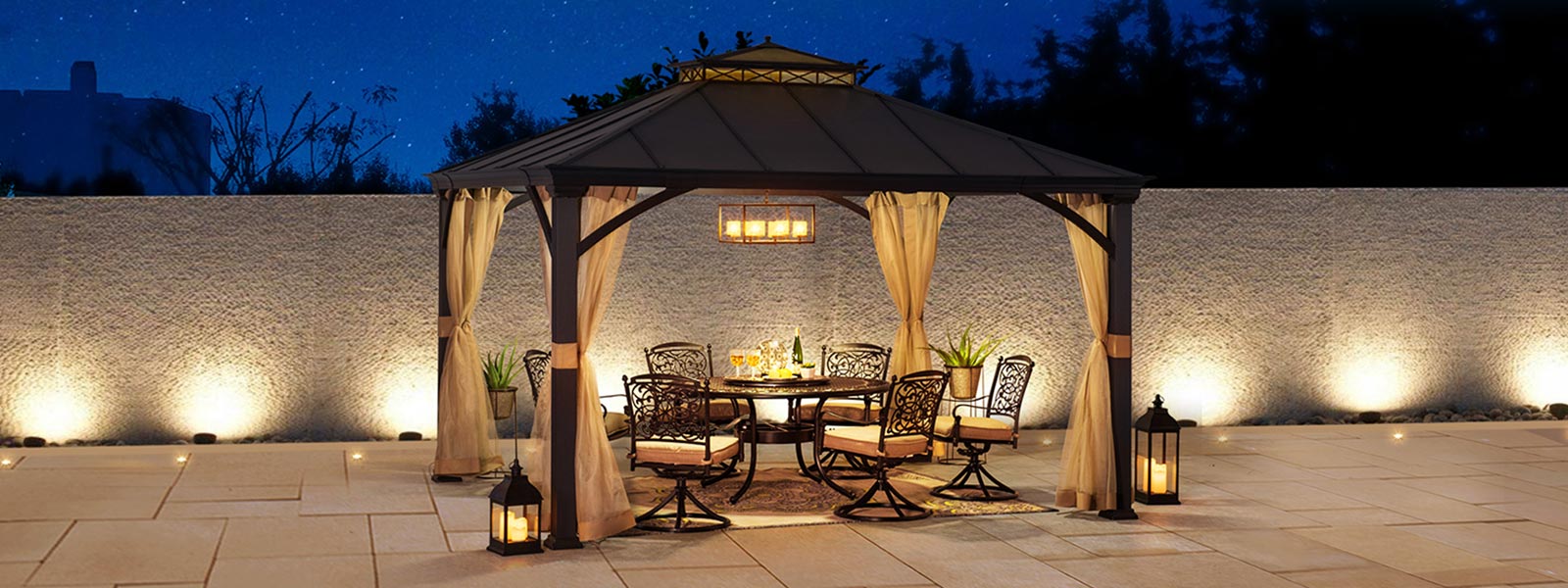
Picture this: a sunny Saturday, a tented barbecue, and 42% of guests ducking every time a breeze picks up—what went wrong? I watched it happen on a June afternoon in 2019; this is exactly where a good steel frame gazebo should have saved the day, but didn’t. (Yep—been there, messy ketchup and all.)

Spotting the Problem: What Most Metal Gazebos Don’t Tell You
I’ve sold, installed, and retrofitted shelters for over 15 years, and I can tell you the obvious fixes—stronger bolts, better canopy fabrics—only mask deeper faults. In one case, a 12×12 powder-coated pavilion delivered to a rooftop bar in Brooklyn in March 2020 failed because the spec sheet ignored wind load and anchoring details; the result was a $3,500 repair and a very angry client. That taught me fast: galvanized steel and a pretty truss don’t equal stability by default. You’ll hear sales reps rattle off terms like “rust-resistant,” but I’ve learned to ask for design drawings, load ratings, and the exact fastening method.
Hidden pain points tend to cluster into three camps: corrosion pathways (poor welds and thin coatings), inadequate anchoring for local wind conditions, and lightweight roof designs that collect snow or water. I’m blunt about this—manufacturers often skimp on thicker tubing to cut costs, and that powder-coated finish? It chips where water collects, accelerating corrosion. Those are small savings that lead to large returns (on warranty claims).
Deeper Layer — Why Traditional Fixes Fall Short
Traditional solutions—thicker fabric, heavier bolts, a bigger canopy—are like putting a bandage on a cracked beam. I remember replacing anchor plates for a coastal nursery in Wilmington in October 2021 after their “standard” gazebo lifted during a gust; the anchors had been undersized for salt-air corrosion. The real issue wasn’t the canopy; it was the connection detail and material selection (galvanized steel vs. stainless; big difference in coastal settings). Designers who downplay corrosion resistance, wind load calculation, and proper anchoring are asking for trouble—and for returns, fast.
Here’s the blunt takeaway: if you want resilience, you need to vet the structural engineering, not just the look. Ask for truss diagrams, live load specs, and a corrosion-resistance plan. Shortcuts feel cheap—until they become emergency invoices. —I still keep a photo folder titled “rookie mistakes” for buyers who insist on the lowest quote.
Real-world Impact
When shelters fail, the consequences are tangible: lost bookings, safety complaints, and that single Yelp review that spreads wider than wildfire. I’ve quantified it—clients who upgraded to proper anchoring and a thicker, powder-coated finish saw repair claims drop by roughly 78% within two seasons. That kind of number matters to wholesale buyers and venue operators.
Forward-Looking Choices: What a Better Steel Frame Gazebo Actually Means
Now let’s get practical. A true upgrade is about system thinking: material specification (galvanized steel or stainless where needed), anchoring strategy (embed plates or heavy-duty ground anchors), and roofing that sheds water and snow. I define a reliable shelter not by brand colors but by three measurable traits: rated wind load, corrosion class, and connection detailing—these are not marketing fluff; they are testable. In my consulting work, I insist on seeing the engineering stamp before approval—no stamp, no buy.
Compare two proposals and you’ll see it: one lists tube diameter and coating type; the other lists “heavy duty” with no numbers. Choose the one with specs. I recently advised a chain of cafes to standardize on a 14-gauge frame and triple-stitched canopy in their coastal stores—turns out standardization reduced replacement cycles by 40% in 18 months. That’s real ROI. —Make decisions using numbers, not promises.

What’s Next
If you’re a wholesale buyer (I’m looking at you), move from impression-based buying to metric-based buying. Here are three practical evaluation metrics I use every day: (1) wind-load rating in psf or mph, (2) corrosion class and coating thickness, and (3) anchoring detail with embedment depth or anchor size. Compare proposals using these three metrics and you’ll cut surprises—fast.
Finally, I’ll say this plainly: aesthetics matter, but longevity pays the bills. I’ve audited warehouses, negotiated bulk orders, and even supervised an emergency retrofit on a rooftop venue in August 2022—experience you can use. For smart, spec-driven steel frame gazebo choices, trust tested suppliers; I often point clients toward suppliers who publish full specs and stand behind them. Learn from my mistakes—and from the numbers. Visit SUNJOY for examples and spec sheets that actually tell the story: SUNJOY.