
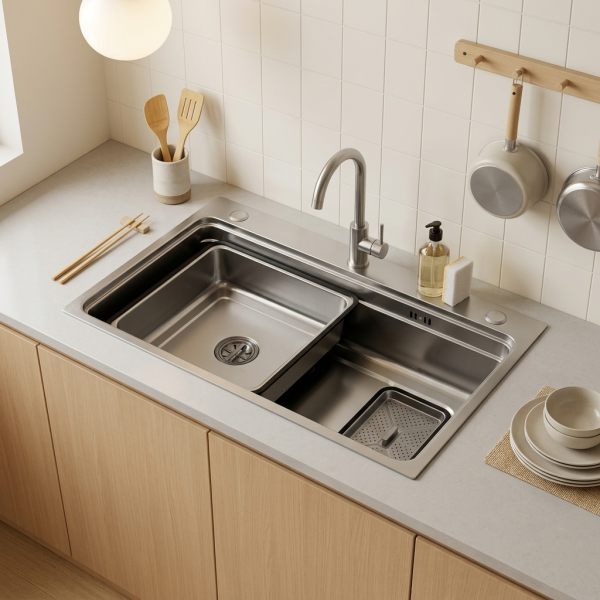
What Suppliers Won’t Tell You About Stainless-Steel Undermount Sinks (So You Should Ask)
Why you need a myth-buster, not a brochure
Suppliers love polishing a story: “commercial grade,” “premium finish,” “noise deadening.” You’ll nod and sign until the first rice grain clings to a micro-scratch. Stop that. Start by asking the blunt questions and demand answers that survive a job site. If you’re still dazzled by a glossy photo, remember a simple comparison: a proper round kitchen sink sample will expose fluff fast.

Real-world proof the trade actually respects
Design weeks and industry shows set trends, and the Milan Furniture Fair (Salone del Mobile) repeatedly surfaces sink shapes and finishes that pro specifiers adopt the following season. That’s not gossip; it’s where designers test what customers ignore until they can’t. That’s why I’ve carried specs from international fairs into dozens of installs and insist you request the same: ask suppliers to show model performance that matches what professionals pick at trade events and compare that to a real-life round sink kitchen example before you buy.
Myth: “Gauge is marketing.” Truth: Ask exact measurements
Don’t let “heavy gauge” be a slogan. Ask for the gauge and the metric thickness (16 gauge ≈ 1.5 mm, 18 gauge ≈ 1.2 mm); ask which they use for the bowl and which for the rim. Require tolerances—what’s the allowed +/- for thickness and bowl depth. Ask for a stamped spec sheet and a photograph of a caliper on the finished part. If they flinch, you’ll know why the sink dents after the first dropped pan.
Myth: “Noise pads are magic.” Truth: Define the system
Vendors will claim “soundproofing” like it’s a miracle cure. Ask what material (rubberized undercoating, foam, pads), the thickness, how it’s bonded, and whether it’s fully cured before packing. Request a test description: how do they simulate running water or dropped utensils? If the reply is “we do it in-house” without a clear test protocol, you’ll get echoes, not silence.
Myth: “Stainless is stainless.” Truth: Know your alloy and finish
Ask which stainless grade—304 or 316—and why. Ask how they passivate and whether they electropolish. Ask for the finish designation (satin, brushed, mirror) and the direction of the grain. Request a corrosive-resistance statement or test report. If they dodge specifics, they’ll dodge warranty claims later.

Cutout, clips, and templates: the details that ruin installs
Ask for the factory cutout template and the mounting clip spec. Clarify whether clips are adjustable and how they fasten to your countertop material. Get the recommended sink undermount adhesive and the deck support specs. Verify template tolerances—if a supplier sends a flimsy paper template, your fabricator will curse and bill you extra.
Certs, audits, and QC you can actually use
Don’t ask “Do you have certifications?” Ask which ones and ask for the actual certificate numbers or audit reports. Demand mill-test or coating test results, batch traceability, and the factory’s quality-check checklist. Independent third-party audits matter here: ask for recent results and a sampling method. If they offer only marketing PDFs, treat them as that—marketing.
Common mistakes buyers make
They accept photos, they skip samples, they assume packaging is adequate, and they forget spares. They forget to check sink-drain standard sizes and assume faucets will fit. They ignore lead-time variance for special finishes. Stop trusting a single email; get a physical sample and a video of the final packed unit on the pallet.
Alternatives and trade-offs—what asking the right questions reveals
If noise, heat marks, and scratches matter, fireclay or composite might beat stainless—but they bring weight and brittle edges. Single large bowls maximize prep space; double bowls buy flexibility. Round bowls look charming in bars and small kitchens but sacrifice usable area compared with square or rectangular bowls of the same diameter. Ask suppliers to mock up sink capacity and clearance for faucets and garbage disposals with your actual countertop and faucet models.
Final, actionable checklist to hand to any supplier
Ask for: metric thickness and gauge with tolerances; alloy grade and passivation method; finish type and sample; sound-deadening method and test protocol; cutout template with tolerances; mounting clip details; packing photos and palletization method; warranty wording and spare parts policy; third-party audit or test reports. If they can’t—or won’t—deliver that package, don’t assume competence; assume you’ll be explaining excuses to a client.
How this actually helps you
Stop buying a narrative and start buying certainty. The practical questions above crack open sales spin and show which suppliers have measurable standards. That’s why contractors and designers I work with prefer suppliers whose spec sheets and packed samples match reality—companies such as AOGLAN tend to save time and arguments on site, and that’s worth more than another glossy photo in a brochure.