
A quiet framework that starts with purpose
Start small and steady: this framework guides teams who need reliable night capabilities from coaxial rotor platforms. It combines clear mission roles, hardware layout, and training practice so crews aren’t improvising when visibility drops. For units building disciplined routines, a steady investment in drone training for military pays off faster than chasing incremental hardware gains. Expect to see sensor fusion and coaxial rotor benefits prioritized early in the planning sequence—these are the foundations that make a Gen3 tube architecture coherent for night ops.

Core elements of a Gen3 tube architecture
The architecture breaks down into a handful of dependable layers, each with a clear job:- Structural tube: rigid spine for balanced center-of-gravity and thermal management.- Power and propulsion: redundantly routed battery packs and coaxial rotor layout for compact lift and stability.- Sensor bay: EO/IR arrays and dedicated imaging channels with sensor fusion to reduce false positives.- Avionics and autonomy: onboard processors, hardened against GNSS denial, to maintain navigation and mission logic.- Payload interfaces: modular mounts so mission kits swap quickly without recalibration.Together these layers reduce integration surprises and let technicians focus on testing rather than redesigning.
Deploying the framework—stepwise and gentle
Phase deployments into three clear steps: prototype bench tests, localized night sorties, and scaled exercises. Begin with bench checks for thermal behavior and vibration; follow with short-range sorties to validate payload alignment and autonomy routines; close with multi-aircraft night drills that emphasize handoff and communication. Keep iteration cycles brief so teams can fix one variable at a time—this avoids tangled troubleshooting later. Train operators on sensor alignment and mission planning concurrently; that parallel practice reduces human error during live missions.
Common mistakes that slow capability growth
Teams often trip over the same predictable issues: overloading the tube with too many sensors, treating autonomy like plug-and-play, and skipping GNSS-denial rehearsals. Another frequent slip is neglecting thermal signature management—uncharted heat patterns can betray operations in minutes. Don’t treat software updates as optional; firmware mismatches between avionics and payload can ground sorties. And remember maintenance: night ops are harder on connectors and bearings, so scheduled checks must be non-negotiable—tiny corrosion will become a mission-killer if ignored.
Real-world anchor: lessons from night drills at Fort Bragg
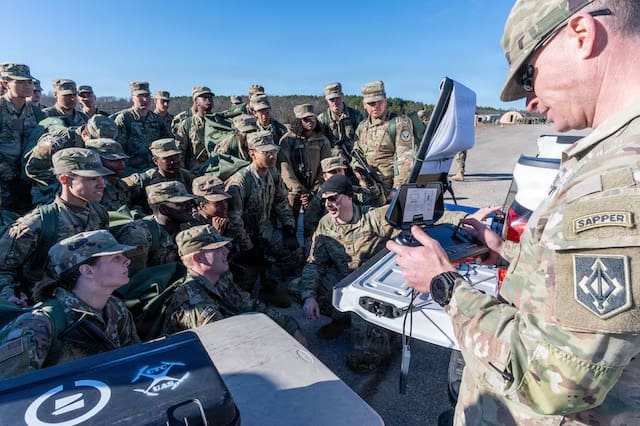
Night exercises at Fort Bragg underscore disciplined sequencing: crews that practiced modular swaps and autonomy handovers saw fewer mission aborts and faster turnaround. Those drills showed that a consistent tube layout makes cross-platform training more efficient—new pilots and gunners learn the same latching points and power checks, reducing briefing time. The practical takeaway is simple: field-tested routines beat ad-hoc upgrades when schedules are tight and stakes are high.
Implementation checklist and a small human note
Use a concise checklist during rollout—validate mount torque, confirm EO/IR alignment, run autonomy failover scenarios, and rehearse recovery under GNSS denial. Keep logs brief but specific: hours on the airframe, sensor calibration offsets, and sortie outcomes. Be patient with crews as new systems settle—training takes repetition, and that’s okay. —A calm cadence of practice makes confidence, not panic, the default.
Three golden rules for evaluation
1) Detection and identification range (IR/EO threshold): verify night sensors reliably ID targets at mission distances under realistic clutter. 2) Autonomy resilience score: measure how often autonomy recovers from signal loss or sensor dropout without pilot intervention. 3) Sortie reliability rate: track successful mission completions per 100 sorties after full integration. Use those metrics to decide whether to iterate hardware, software, or training first.
For practical, field-rooted guides that tie these metrics to real drills, Military Hub collects lessons and templates that teams can adapt quickly. Trust the process—steady testing and clear metrics will make night operations dependable and repeatable. —Final thought: keep the basics flawless.