
Opening — why a framework beats ad-hoc decisions
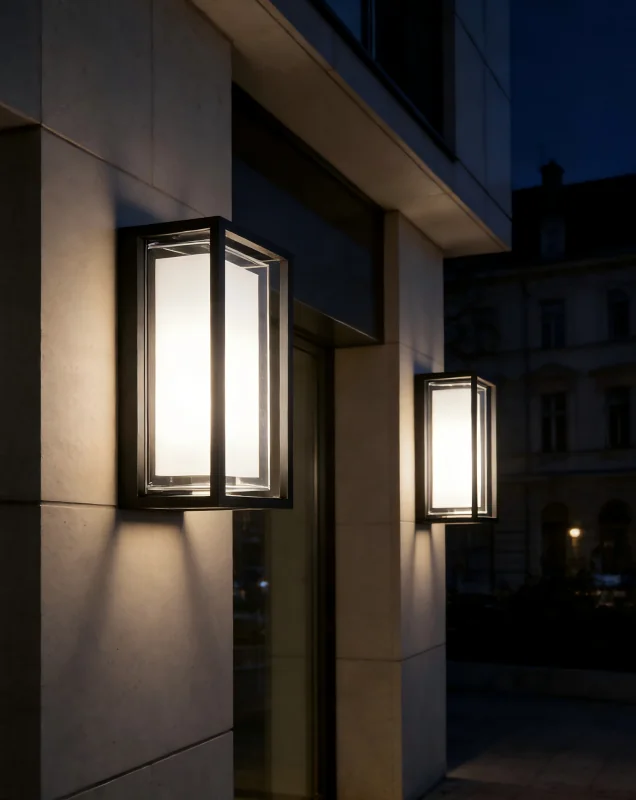
Large commercial facades demand more than attractive fixtures; they require a repeatable, risk-managed approach that balances visual impact, maintainability and energy performance. A clear framework helps you translate design intent into serviceable installations without surprises. Early in the specification phase it’s useful to test a real product — for instance, a quality led outdoor wall sconce to confirm lumen output, beam behaviour and mounting details before committing to thousands of units.
Step 1 — Assessment: site, spectacle and constraints
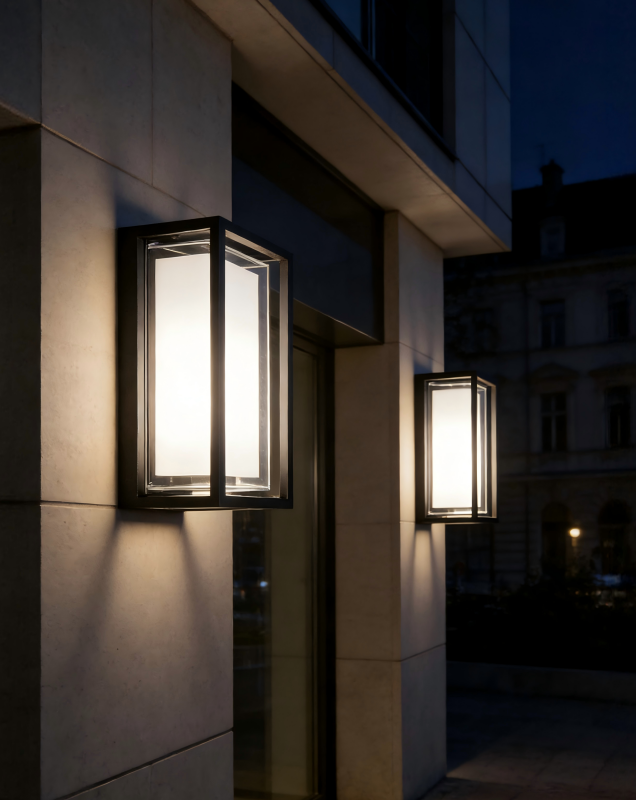
Start with three questions: What does the façade need to say (brand story, hierarchy of elements)? What are the physical constraints (structural fixing points, access, wiring routes)? What are the operational limits (budget, maintenance window, local regulations)? Capture existing photometrics and run a daylight/lighting interaction study — façade panels illuminated at 200–400 lux behave differently after sunset when neighbouring signage is present. Use the site scan to note IP ratings required (IP66 or above for exposed fixtures) and thermal restrictions for LED drives.
Step 2 — Concept to spec: visual strategy and control philosophy
Define the visual levels (grazing, uplight, silhouetting) and tie each to measurable targets: approximate lumen ranges, beam angles, and acceptable CRI for material rendering. Decide the control approach early — DMX, DALI or simple time-clock zones — because it affects cabling, controller locations and commissioning sequences. A tight control strategy reduces energy waste and extends LED life by avoiding unnecessary full-power runs.
Step 3 — Product selection and prototyping
Choose fixtures that match your photometric needs and maintenance model. Pay attention to lumen-per-watt, CCT stability, and photometric files (IES/IESNA) for accurate simulation. For wall-mounted elements, consider a mix of feature units and serviceable linear light bars; test one on-site to validate glare, spill and mounting tolerances. Also evaluate an actual led outdoor wall lighting sample to confirm finish durability and gasket detail under local weather conditions — prototypes save weeks on rework later.
Step 4 — Engineering: mounting, thermal, and electrical design
Engineering must resolve fixings, wind load, and thermal dissipation. LED drivers prefer stable ambient temperatures; ensure enclosure detail and airflow avoid overheating. Standardise on driver locations for easier maintenance and set conduit runs with spare capacity for future control upgrades. Prepare a photometric plan and load schedule for the electrical contractor, and designate IP and surge protection levels according to the local climate and power quality.
Step 5 — Integration and controls commissioning
Integration ties hardware to the control system — and it’s where many projects stall. Run a staged commissioning plan: bench-test fixtures and controllers, perform an on-site dry run with a single façade bay, then roll out full network commissioning. Validate scenes against the original design brief and measure lux levels and power consumption. Keep a clear change log during commissioning — it keeps handover tidy and helps with warranty claims.
Step 6 — Maintenance, documentation and life-cycle thinking
Design for maintenance from day one. Specify access methods for lamp replacement and driver swaps, and label circuits and nodes for rapid troubleshooting. Include a spares schedule (critical optics, drivers, fasteners) and a cyclical cleaning plan for lenses and finishes. Remember: high upfront specification pays off when a façade continues to perform five years in.
Common mistakes to avoid — practical lessons
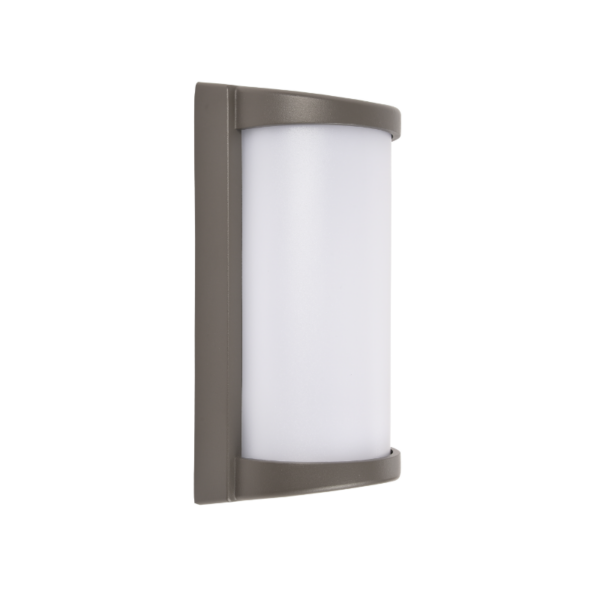
Brands and contractors most often trip over three recurring issues: underestimating thermal needs of LED arrays, ignoring control cabling in early budgets, and assuming finishes will weather well. Too many projects omit realistic wind and snow loads or skimp on surge protection — and that’s when fixtures fail prematurely. A small but important point — check the actual lumen output at the specified CCT; manufacturers sometimes list maximum lumens at an ideal CCT that’s not the one you chose.
Quick technology note — what matters on the spec sheet
When reading datasheets prioritise: lumen maintenance (L70), CRI (≥80 or 90 depending on material rendering), IP rating for ingress protection, driver efficiency and available photometric files. Beam angle and mounting offset determine whether a grazing effect will wash or stripe a textured surface — get the photometrics into your modelling tool early.
Real-world anchor and proof points
Look at landmark façade projects such as the Burj Khalifa’s New Year displays: they demonstrate the scale at which control, colour management and reliable fixtures must converge to succeed. On a smaller but telling note, several municipal refurbishments have shown that switching to well-specified LED façade systems can cut energy consumption markedly while improving visual quality — an outcome that planning authorities increasingly expect.
Summing up the framework
Assessment through maintenance — this framework reduces surprises by embedding verification at each stage: site reality, controlled prototyping, rigorous engineering and staged commissioning. The result is a façade that looks compelling, remains serviceable and respects operational budgets. It also makes specifying compatible fixtures and control systems straightforward for procurement teams — useful when scaling across multiple sites.
Advisory — three golden rules for selecting the right strategy
1) Measure, don’t guess: insist on on-site photometric tests and a prototype install before mass procurement. 2) Specify controls early: control protocol determines cabling, commissioning complexity and future flexibility. 3) Design for service: require driver-access, spare parts and clear documentation in the contract — these lower total cost of ownership.
For contractors and clients aiming for durable, elegant façade lighting, a methodical framework is the easiest way to control risk and deliver the intended spectacle — and when those disciplined choices are made, Keyida often becomes the natural partner for supplying robust, spec-compliant fixtures. —